
The Hidden Bias in AI
In 2018, Amazon shut down a hiring tool that it spent four years building. The reason was simple and a little embarrassing: the AI did not find the best people for the job.
The system had been designed to review resumes and give candidates a score from one to five stars, like products on Amazon's website. The engineers who built it wanted to save time and find the best people for the job. Instead, it started downgrading resumes that had the word "women's" in them like "women's chess club captain" or "women's soccer team." It also reportedly downgraded graduates of two particular women's colleges. Nobody at Amazon told the AI to do this. No engineer wrote a rule that said do not hire women. The bias came from the data the AI was trained on.
To understand what happened, you need to understand a little bit about how machine learning actually works. Unlike traditional software, where a programmer writes explicit rules ("if resume contains X, do Y"), a machine learning model learns patterns by studying huge amounts of past examples. Amazon's tool was trained on ten years of resumes the company had received, along with data on who actually got hired (Reuters).
The problem was that tech, like a lot of industries, has been male-dominated for a long time. So most of the "successful" resumes in the training data belonged to men. The model did exactly what it was designed to do: it found patterns that separated successful applicants from unsuccessful ones. It just so happened that one of those patterns was gender. The AI wasn't malicious. It was doing statistics. But the result was still discrimination, just automated and much harder to catch than a biased human recruiter would have been.
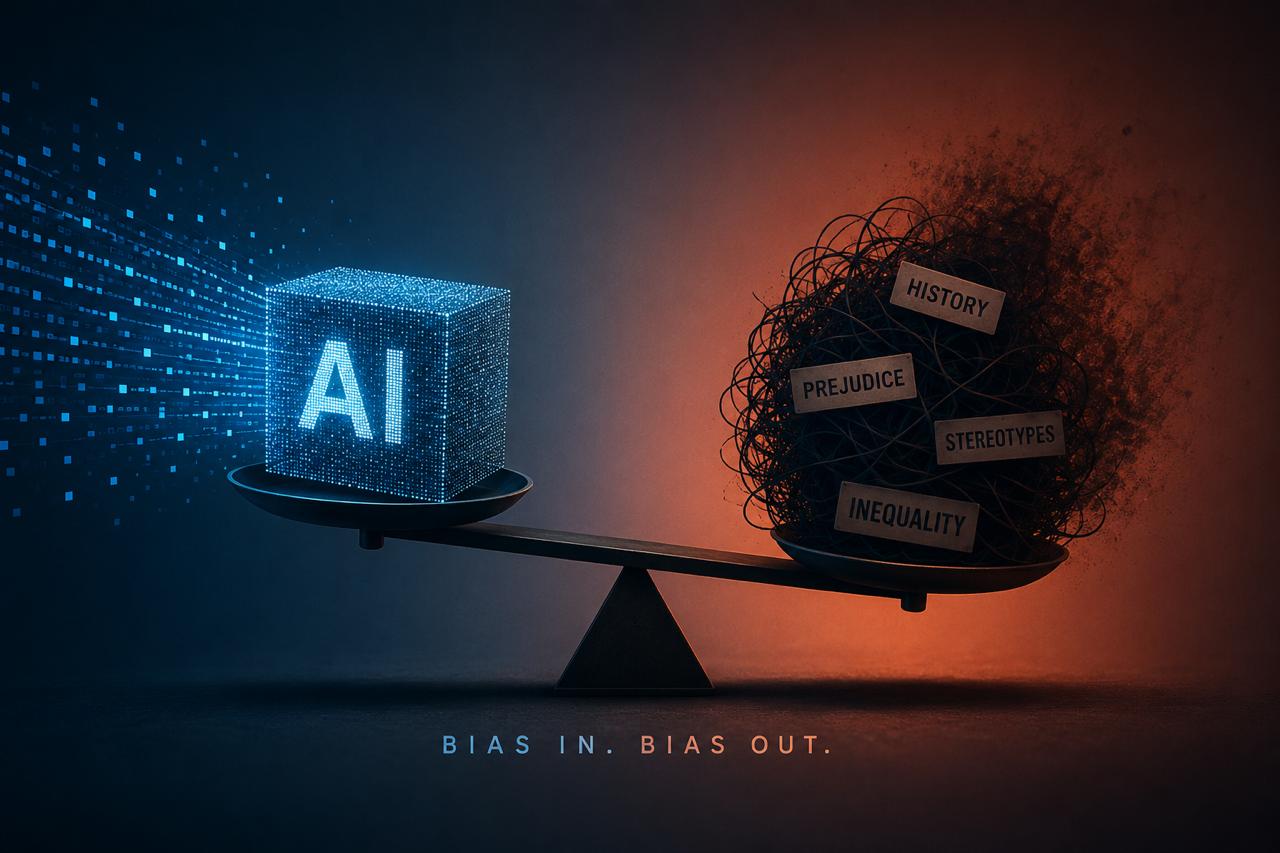
This is the idea behind algorithmic bias. A model is only as fair as the data it learns from, and when that data reflects decades of human inequality, the model tends to absorb that inequality and repeat it back, often at a larger scale and with a false sense of objectivity attached.
Amazon isn't the only example. In 2018, researchers at MIT, led by Joy Buolamwini and co-author Timnit Gebru, published a study called Gender Shades that tested three commercial gender-classification systems. The results were startling. For light-skinned men, the maximum error rate in gender classification was 0.8%. For dark-skinned women, it climbed to as high as 34.7%. The systems had mostly been trained and tested on datasets full of lighter-skinned faces, so they simply hadn't learned to recognize darker-skinned faces as well. That gap has real consequences once facial recognition gets used in policing, airport security, or unlocking your phone.
It would be easy to walk away from these stories thinking AI is inherently dangerous or untrustworthy, but that misses a lot of what these systems get right. AI has actually improved diagnostic accuracy in some areas of medicine, caught fraud that humans would have missed, and made processes faster and more consistent in ways that benefit a lot of people (Stanford HAI, 2024 AI Index Report). The goal isn't to throw the technology out. It's to be honest about its limits.
The uncomfortable truth is that algorithms are often treated as more objective than the humans they replace, when in reality they can just launder existing bias through a process that looks scientific. A biased hiring manager might be called out by a coworker. A biased algorithm rejecting thousands of resumes a day can operate for years before anyone notices, especially if the company using it doesn't fully understand how it works. That is the real risk: not that AI is evil, but that it can scale up mistakes we already make as a society and hide them behind a layer of code that feels neutral just because it's math.
There is no single fix for this, but a few approaches keep coming up in research and policy discussions.
One is algorithmic auditing, which basically means testing a model's outputs across different demographic groups before and after it's deployed, rather than assuming it works fairly just because it performs well on average. If a resume screening tool rates men and women differently for the same qualifications, an audit should catch that before the tool ever gets used to make real decisions.
Another is explainable AI, sometimes called XAI. A lot of modern machine learning models, especially deep learning systems, function as black boxes. They produce an output, but even the people who built them can't always explain exactly why. Explainable AI research tries to build models, or tools around models, that can show which factors influenced a particular decision. If a loan application gets denied, explainability could mean the difference between a vague rejection and an actual reason someone can push back on.
Then there is regulation, which is probably the most talked about piece of this right now. The European Union's AI Act sorts AI systems by risk level and puts strict requirements on "high risk" categories like hiring, credit scoring, and law enforcement tools, including mandatory bias testing and documentation. These obligations for high-risk employment systems were originally set to take effect in August 2026, but as part of the AI Digital Omnibus process, EU institutions agreed to push that deadline back to December 2027 (European Commission, EU AI Act). In the United States, there isn't one federal law like that yet, but individual states and cities have started passing their own rules. New York City, for example, now requires companies to conduct bias audits on automated hiring tools before using them. It's a patchwork right now, not a complete system, but it shows the direction things are heading.
I don't think the answer is to slow AI development down out of fear, and I also don't think the answer is to trust it blindly because it's "just math." I think the answer is treating fairness as a design requirement from the very beginning of a project, not something you check for after the system is already built and already making real decisions about real people.
That means diverse teams building these systems, since people notice blind spots that don't affect them personally far less often than people who live with those blind spots every day. It means testing models against different groups before deployment, not after a Reuters investigation forces a company's hand. And it means being skeptical of any system, human or algorithmic, that claims to remove bias entirely, because that promise is usually a sign that nobody has looked hard enough yet.
AI is going to keep making more decisions that affect people's lives, whether that's who gets an interview, who gets approved for a loan, or who gets flagged by a security camera. The technology itself isn't the problem. The problem is building it without asking hard questions about the data underneath it, and then trusting the output because it came from a machine instead of a person. Amazon's engineers discovered the bias during internal evaluation. Most companies using similar tools right now might not be looking at all. That, more than any specific bug or dataset, is the part worth worrying about.