
"The Dolphin Kick: Why Swimmers Move Faster Underwater than on The Surface of the Water"
Introduction
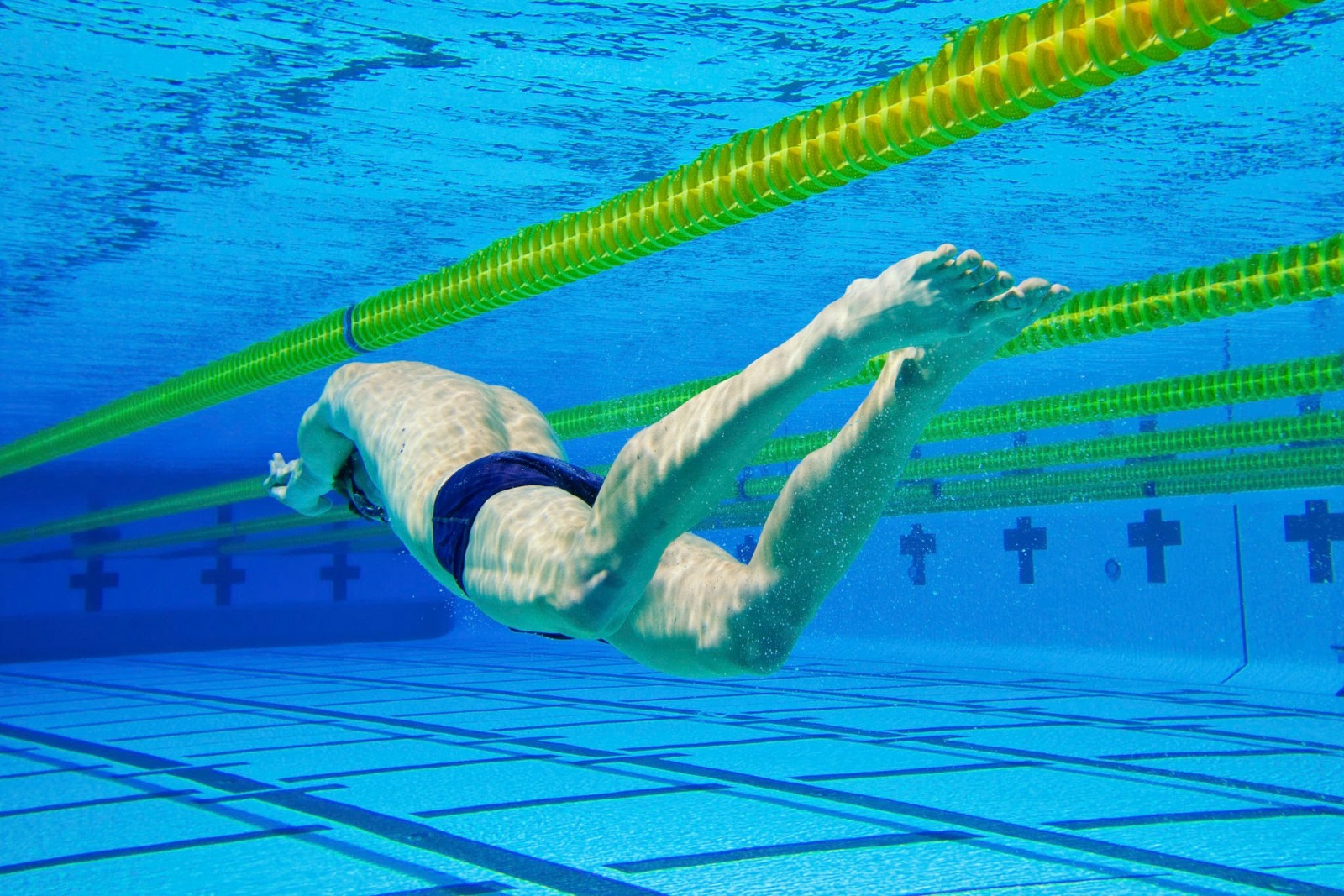
During elite competitions (such as Olympic swim races), spectators may notice that swimmers do not begin their surface strokes immediately after diving in. Instead, they stream through the water fully submerged. They undulate like a bottlenose dolphin.
Water is approximately 800 times as dense as air. Because of this high density, swimmers utilize a technique called underwater dolphin kicking to move more efficiently while fully submerged. However, density is only one part of the equation: overall hydrodynamic drag also depends on speed, body position, frontal area, and the swimmer's drag coefficient.
The Problem with the Surface
To understand why underwater dolphin kicking can be faster than surface swimming after starts and turns, it helps to look at what happens when a swimmer moves along the pool's surface.
The faster you attempt to swim along the surface, the bigger that front wave becomes, creating a wall of water resistance. Submerging completely sidesteps this problem entirely, allowing swimmers to glide forward without fighting the very waves they create.
By diving just a few feet deeper beneath the surface, athletes escape the severe effects of wave drag altogether, entering an environment where water flows smoothly over their bodies. This dramatic drop in surface resistance means every ounce of muscular power goes straight into launching the swimmer forward, unlocking maximum efficiency and peak velocity deep below the pool's surface.
How Wave Drag Works
Whenever a swimmer glides across the top of the water, their body acts like a boat hull, constantly plowing through the liquid. This displacement creates two distinct surface wave systems: a bow wave, a dense crest of water that piles up directly in front of the swimmer's head and chest, and a wake, a trailing series of turbulent waves formed behind the swimmer as the displaced water crashes back together.
In the world of physics, this dynamic creates a powerful force called wave drag.
What is Wave Drag? Wave drag is a type of fluid resistance that occurs when a swimmer moves along the boundary between air and water, specifically at the surface of the pool.
Generating these surface waves requires a massive transfer of energy, directly from the athlete's muscles into the water. Every splash, spray, and ripple represents kinetic energy that could have propelled the swimmer forward down the lane. Instead, most of that effort gets wasted creating the bow wave and wake.
This is what makes wave drag so punishing: the faster a swimmer tries to go on the surface, the larger and heavier that front bow wave becomes. The swimmer is essentially forced to expend extra energy trying to climb over a moving wall of water that their own body created.
Despite how much faster it is to stay underwater, swimmers eventually have to resurface because of strict rules, physical limits, and basic timing. As stated in the USA Swimming 2025 Rule Book on page 23:
“It shall be permissible for a swimmer to be completely submerged for a distance of not more than 15 meters (16.4 yards) after the start and after each turn”.
So, USA Swimming caps underwater kicks at 15 meters after every start and turn, so breaking that line means getting disqualified on the spot. The strokes that pertain to this are Freestyle, Backstroke, Breaststroke, and Butterfly.
Also, sprinting while holding your breath tanks your oxygen and builds up CO2 way faster, so your body has to switch to anaerobic mode. You get completely exhausted, but it's actually metabolic acidosis doing that to you, not just the lactate.
Finally, your speed off the wall naturally slows down the further you go, so once your underwater kick starts moving slower than your actual stroke, staying down just holds you back.
Biomechanics of the Undulation
Think of undulation in swimming as a human whip.
Instead of just kicking your legs like you do during a basic flutter kick, full-body undulation uses your entire torso and legs to create a continuous, flowing wave. The movement starts up near your upper body and works its way all the way down to your toes:
- The core engine: You press your chest down into the water, which naturally forces your hips to rise toward the surface.
- The wave transfers: As you pull your chest back up, that kinetic energy travels straight through your core, lower back, and hips, rolling smoothly down through your thighs while bending your knees just a bit.
- The whip snap: Your lower legs and feet snap downward like the tip of a whip, releasing a sharp burst of force that propels you forward.
To a non-swimmer, it looks just like a dolphin moving through the water. By engaging your entire torso (activating the core, lower back, and glutes alongside the legs), you turn your body into a fluid wave. This undulation allows you to generate massive propulsive force while maintaining a sleek, low-drag posture underwater.
The real secret comes down to flexible ankles: as your feet snap down at the end of the wave, they function like built-in swim fins, catching the water and driving your body forward down the lane.
“Newton's Laws of Motion” in Swimming Overall
Newton's First Law of Motion
NASA states Newton's First Law of Motion as follows:
“An object at rest remains at rest, and an object in motion remains in motion at constant speed and in a straight line unless acted on by an unbalanced force.”
When breaking down elite swimming physics, Newton's First Law of Motion, which notes that a body continues moving straight forward "except insofar as it is compelled to change its state by forces impressed", explains why a streamlined dolphin kick is essential to combat loss of speed.
At peak velocity after a dive, water drag acts as that constant external force stripping away momentum. Inertia alone cannot preserve forward motion, so acceleration ultimately depends on the moment-by-moment battle between generated thrust and fluid drag:
Fnet = Fthrust - Fdrag
When a powerful kick generates thrust that overwhelms drag, the swimmer surges forward; conversely, during recovery strokes or minor alignment slips, drag momentarily takes over and causes rapid deceleration.
Newton's Second Law of Motion
NASA states Newton's Second Law of Motion as follows:
“The acceleration of an object depends on the mass of the object and the amount of force applied.”
Newton's Second Law, F = ma, shows how force drives the acceleration of the swimmer's body mass. In underwater dolphin kicking, acceleration constantly fluctuates with each kick cycle.
By analyzing high-frequency data, the “Swimming in Data” study illustrates net acceleration requires maximizing positive kicking force while minimizing body drag. Applying F = ma helps swimmers adjust their kick frequency and body angle so the net force stays positive throughout both the upward and downward motions.
Newton's Third Law of Motion
NASA states Newton's Third Law of Motion as follows:
“Whenever one object exerts a force on another object, the second object exerts an equal and opposite on the first.”
As stated in “Swimming in Data”, equal and opposite is how a swimmer turns the movement of the body into a win. As a swimmer's hands push backward against the water, the water pushes the hand, and the body connected to it, forward with equal force.
Similarly, when the legs kick back during flutter and dolphin kicks, the reactive force from the water pushes the body forward. This illustrates Newton's Third Law in action, showing how a swimmer can only launch themselves forward by physically pushing the water backward.
Conclusion
Ultimately, the underwater dolphin kick is significantly more than just a flashy maneuver; it's truthfully a brilliant example of human physics and biomechanics. By diving deep off the walls, swimmers escape the punishing trap of surface wave drag. Instead of wasting precious muscular energy churning up splashes and fighting self-made bow waves, athletes capitalize on water density, using its high resistance to anchor their kicks while generating explosive forward thrust.
Combining this streamlined positioning with full-body undulation unlocks incredible athletic efficiency. By whipping the core, hips, and ankles together in one continuous wave, swimmers basically transform into aquatic sprinters, generating massive underwater propulsion while saving their vital strength for the rest of the race.
References
- “Swimming in Data” - https://link.springer.com/article/10.1007/s00283-024-10339-0
- USA Swimming 2025 Rule Book - https://www.usaswimming.org/docs/default-source/governance/governance-lsc-website/rules_policies/rulebooks/2025-rulebook.pdf
- NASA Newton's Three Laws of Motion - https://www1.grc.nasa.gov/beginners-guide-to-aeronautics/newtons-laws-of-motion/